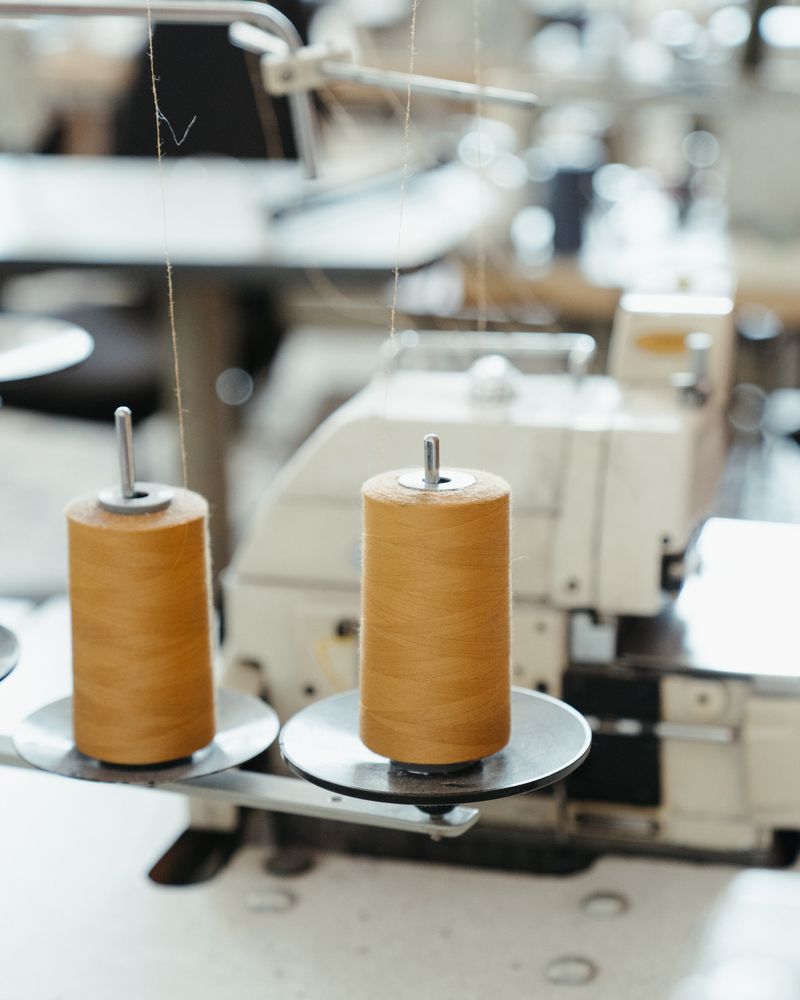

Activewear is the most technical and most country-specific category in modern apparel sourcing. Unlike streetwear or knits, where Portugal or Turkey can deliver against China on most specs, activewear is gated by machinery — seamless circular knitting, sublimation printing, bonded seams, four-way stretch finishing. Most of that machinery is in three countries. This dossier compares China (seamless dominance), Vietnam (cut-and-sew at scale), Turkey (premium knit and synthetic blends), and Portugal (small-batch and recycled content) — with MOQ, lead time, and FOB benchmarks across compression tights, performance tees, training shorts, and tracksuits.
Why activewear is country-gated
Three machines define modern activewear production. Seamless circular knitting machines (Santoni, Merz, Pilotelli) produce one-piece compression garments with engineered zoning — they cost €40–80k per unit, and a competitive activewear factory operates 40–200 of them. Sublimation printing requires polyester base fabric, calendaring kit, and tight colour management. Bonded-seam construction (ultrasonic welding instead of stitching) requires Macpi or similar specialised equipment. The countries that dominate activewear are the countries where all three machines are clustered in one supply chain.
This is why a buyer cannot simply 'find a Portuguese activewear factory.' Portugal has world-class cut-and-sew capability, but its seamless capacity is a fraction of China's. A buyer placing seamless compression styles in Portugal is not necessarily sourcing wrong — they are sourcing against a different machine base, with different MOQs and prices reflecting it.
Country comparison: the four dominant activewear sources
China (Guangdong, Fujian, Zhejiang)
The seamless capital. Estimated 60% of global seamless circular knitting capacity sits in three Chinese provinces. China dominates compression tights, sports bras, seamless tanks, technical underwear, and one-piece training garments. The supply chain is fully integrated — yarn (Italian-imported or domestic), seamless knit, dye, finish, cut-and-sew or finishing trim, packaging — all within 200km. MOQs run lower than perception suggests: workable MOQs of 300–500 per style on seamless are achievable with stock yarn. Sublimation print capacity is also strongest here. The downside: tariff exposure into the US (Section 301), longer lead times, and the political/operational complexity of producing in mainland China for Western brands.
Vietnam (Ho Chi Minh City, Binh Duong, Long An)
The cut-and-sew scale leader. Vietnam dominates structured activewear — training shorts, woven jackets, tracksuits, multi-panel cut-and-sew tees. Capacity is enormous; lead times for stock-fabric runs of 1,000–5,000 units are competitive with anywhere on earth. Tariff position into the US is materially better than China. Seamless capacity is limited but growing — most seamless production in Vietnam is by Chinese-owned factories that relocated for tariff arbitrage. Workable MOQs are higher than China for small orders, lower than China for large orders (the operational sweet spot is 1,500+ units).
Turkey (Istanbul, Izmir, Bursa)
Premium polyester knit and synthetic-blend specialist. Turkey punches above its global activewear share because of vertical integration — yarn extruders, knitters, dye houses, garment finishers all within Marmara region. Strongest on technical synthetic tees, branded sportswear, structured tracksuit tops. Seamless capacity is moderate; sublimation is excellent. Lead times into the EU are unmatched (truck delivery 4–7 days). FOB cost sits ~15–25% above China for comparable spec.
Portugal (Vale do Ave, Barcelos)
Small-batch specialist with the strongest organic and recycled-content claim. Activewear in Portugal is dominated by cut-and-sew on technical knits — Italian-yarn jerseys, Tencel blends, recycled polyester. Seamless capacity is limited (Portugal hosts maybe 5% of European seamless capacity). The Portuguese activewear story is brand-driven — premium small-batch capsules, sustainability-positioned drops, EU-tariff-free entry. MOQs run 100–300 units per style; FOB sits 40–70% above China for comparable spec.
Bangladesh (Dhaka, Chittagong)
Bangladesh has emerged as a serious activewear contender for volume-driven basics. The country's strength is cut-and-sew at extreme scale on basic knit constructions — single-jersey performance tees, fleece-back tracksuits, basic training shorts. Seamless capacity is minimal; sublimation print exists but in limited concentrations. The economics work for orders above 3,000 units per style on basic constructions; below that, MOQ pressure and lead-time variance erode the cost advantage. Trade preference into the EU under EBA (Everything But Arms) remains a material advantage. Audit-quality variance is the operational risk — buyers should pair sourcing with a strong third-party inspection partner.
Pakistan (Lahore, Karachi, Faisalabad)
An underrated activewear source for cotton-blend basics and fleece. Pakistan dominates fleece-back production at the value tier — heavyweight tracksuit components, hooded sweatshirts with technical finishing, brushed-jersey training tops. Synthetic and seamless capacity is limited. The country's cotton heritage means cotton-blend performance pieces (Supima blends, mercerised cotton-poly mixes) are an area of genuine strength. MOQs run higher than China but lower than Bangladesh on fleece-back specifically. Tariff position into the EU is favourable; into the US, less so. Lead times tend to run longer than competitive countries — buyers should plan 85–110 days FOB rather than the China-Vietnam benchmark of 60–80.
India (Tirupur, Bangalore)
India's activewear cluster is concentrated in Tirupur (cotton-blend knits) and Bangalore (technical and circular knits). Strongest on cotton-rich performance basics, organic-cotton activewear, and small-batch technical knitwear. Seamless capacity is growing but still trails the East Asian incumbents. India's regulatory landscape for textile exports has stabilised significantly post-2024 GST reforms, but factory-to-factory variance remains high — diligence on individual suppliers matters more here than in any other major sourcing country. MOQs are flexible at the smaller end and rigid at the larger end. The structural advantage: organic cotton certification and traceability infrastructure are mature.
Country-by-product matrix
| Product | Best country | Workable MOQ | FOB benchmark | Lead time |
|---|---|---|---|---|
| Seamless compression tight | China | 300–500 | €4.50–7 | 60–80d |
| Sports bra (seamless) | China | 300–500 | €3.20–5.50 | 60–80d |
| Performance tee (cut & sew) | Vietnam | 500–1,000 | €3.80–5.50 | 50–70d |
| Training short | Vietnam | 500–1,000 | €4.20–6 | 50–70d |
| Polyester tracksuit set | Turkey | 300–500 | €18–28 / set | 40–55d |
| Synthetic technical tee | Turkey | 300 | €4.50–6.50 | 40–55d |
| Recycled-content capsule | Portugal | 150–250 | €12–18 | 60–75d |
| Premium organic activewear | Portugal | 150–250 | €14–22 | 60–75d |
MOQ realities
Activewear MOQ behaves differently from other categories. Seamless circular knitting setups cost €600–1,200 to open per style — that cost has to be amortised. A factory will not run 100 units of seamless compression in a custom colour even if you offer a premium. The mill minimum on technical yarns also runs higher (typically 300–500kg, equivalent to 500+ units). Buyers who treat activewear MOQ negotiation like cotton-tee negotiation get the wrong answer.
The path to low-MOQ activewear is the same path as low-MOQ knitwear, with one addition: pre-developed factory programmes. Many Chinese and Vietnamese activewear factories run a 'small-batch programme' where they pre-knit a stock of compression tights in standard sizes and standard colours, and you commit to printing or labelling them. MOQ on these programmes can drop to 200 units per style. Ask explicitly.
"The activewear buyer's first decision is not which factory — it is which machine. Get that decision wrong and every subsequent decision compounds the error."
Risk management for activewear sourcing
- Tariff exposure. US Section 301 tariffs on Chinese-origin synthetic apparel run materially higher than on cotton. Re-cost annually and assume policy uncertainty.
- Yarn substitution. Activewear performance is driven by yarn, not just fabric. Verify yarn certificates (Lycra, Coolmax, Repreve) on every order — yarn substitution is the single most common quality regression.
- Wash compliance. Activewear is performance-tested by end users in laundry conditions. Run wash testing before bulk approval — not just at sampling.
- OEKO-TEX or bluesign. Synthetic activewear carries higher chemical risk than cotton. Require OEKO-TEX Standard 100 minimum.
- Sub-contracting risk. Activewear factories with seamless capacity sometimes broker sublimation print to partners. Ask explicitly which steps are in-house.
FAQs
Can Portugal produce seamless activewear?
A small number of Portuguese factories operate Santoni machines but the capacity is limited and MOQs are correspondingly higher. For seamless at scale, Portugal is not competitive with China.
What is the cheapest country for activewear?
On FOB unit cost, China remains cheapest for seamless and Vietnam for cut-and-sew at volume. After tariff and freight, the answer depends on destination market.
How do I verify yarn authenticity?
Request yarn certificates with every PO — Lycra brand certificates, Coolmax certificates, Repreve recycled content certificates. Yarn brands provide verification platforms. Substitute yarn is the most common quality fraud in activewear.
Is Bangladesh a viable activewear source?
Bangladesh has growing capacity in basic activewear and tracksuits but limited seamless or technical capability. Suitable for volume-driven basics; not yet competitive for performance-tier products.
What lead time should I plan for first-order activewear?
60–90 days from PO to FOB on stock-fabric/stock-yarn programmes. 90–120 days when developing custom yarn or custom knit structure. Add transit on top.
- Activewear is machine-gated — choose the country with the right machine, not just the right price.
- China for seamless. Vietnam for cut-and-sew scale. Turkey for EU-fast premium. Portugal for capsule and sustainability.
- MOQ floors are higher than knit categories because setup costs are higher.
- Verify yarn authenticity on every order.
- Split production across countries once volume justifies the complexity.
Browse activewear factories by country
Filter 312 verified activewear specialists by seamless, cut-and-sew, sublimation capability, MOQ floor, and trust score.